
MGB exec vows to keep tabs of Cagayan River magnetite quarry operations set to start in February
By Jonathan L. Mayuga
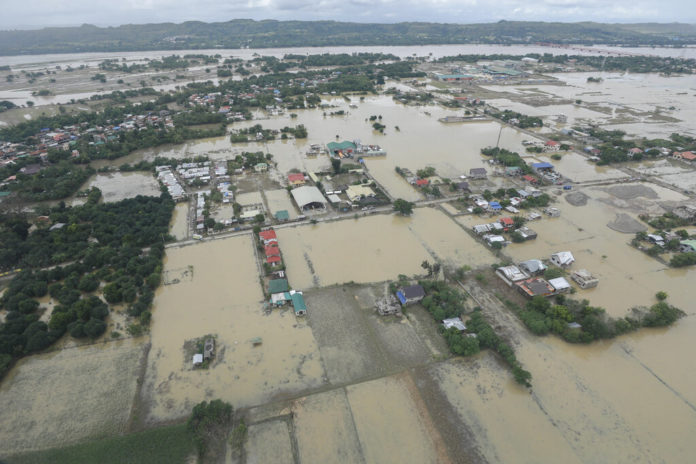
In this handout photo provided by the Malacanang Presidential Photographers Division, floodwaters brought about by Typhoon Vamco inundate Cagayan valley region in northern Philippines on Sunday Nov. 15, 2020. Typhoon Vamco swelled rivers and flooded low-lying areas as it passed over the storm-battered northeast Philippines, where rescuers were deployed early Thursday to help people flee the rising waters. (Ace Morandante/ Malacanang Presidential Photographers Division via AP)
Mining regulators will strictly monitor the extraction of magnetite or black sand in the coastal waters and rivers of Cagayan province, an official of the Department of Environment and Natural Resources (DENR) said on Wednesday.
This as Apollo Global subsidiary JDVC Resources Corp. said it will start commercial operation of the country’s largest offshore mining in the province this month.
A vessel capable of commercial extraction, testing, sampling and production of magnetite iron has arrived and more dredgers are expected to arrive within the next few months.
Under its mining permit, JDVC is allowed to extract mineral resources within an area of 1,902 hectares some 14 kilometers offshore near the coastal territory of Gonzaga, Cagayan.
The company specifically targets iron-oxide or magnetite sand, which is used to essentially produce steel—with China as a major buyer. Based on the company’s estimate, probable ore reserve in the area is around 631.7 million metric tons (MMT).
The project may push through despite stiff opposition by cause-oriented groups, citing potential harmful effect of offshore mining of such a massive scale to the coastal environment and ecosystem, and the marine wildlife in the area.
Mines and Geosciences Bureau (MGB) Director Wilfredo Moncano, in a telephone interview, however, defended the project, saying it has gone through an environmental impact assessment system processes and the company has secured an environmental clearance certificate (ECC) from the Environmental Management Bureau (EMB).
“JDVC has undergone environmental impact assessment and the company was issued an ECC, which means environmental issues have been considered by the EMB,” Moncano stated.
While magnetite or black sand mining is supposed to be banned in the Philippines, the extraction of the said mineral offshore is allowed, he added.
“Mining in shoreline is prohibited but offshore mining is allowed. If it is at least 1,500 meters from the shoreline going out to the sea, it is allowed,” Moncano said, even as he assured the company’s operation will be monitored by the MGB and EMB. Any destruction or damage to the coastal or marine ecosystem, such as corals, by JDVC Resources Corp., will come with corresponding penalty and fine under the mining law.
“What is important is that the JDVC will not cause damage to the coastal or marine ecosystem,” he said.
Meanwhile, magnetite mining in rivers such as the Cagayan River is also allowed for as long as the primary purpose of the project is river rehabilitation or restoration, such as the plan to extract some 7 million metric tons of sand to remove three of the 19 sandbars along its stretch.
He said the DENR-MGB is also tasked to monitor the dredging operations because while the activity is primarily flood mitigation, the minerals to be extracted include magnetite sand.
“Black sand mining is also part of the purposes that’s why we will assess the mineral content of the river channel. If the magnetite sand contained surpasses the threshold of 6 percent, we will charge the company of 4-percent excise tax,” he said.
“He also said every shipment will undergo mineral assessment. Even before shipment, there will be mineral assessment,” Moncano added.
He said the regional directors of the DENR will undergo briefing to familiarize themselves on how to compute taxes based on a mineral assessment to be conducted on offshore mining or mining black sand incidental to river dredging as part of river restoration and flood mitigation projects.
“There is a formula for computing taxes to be imposed on minerals extracted for black sand and it depends on the market value of the mineral and the content of the ores,” he said.
In the massive Cagayan River dredging operation, the DENR said initially, around 7 million metric tons of sand is to be extracted in removing three of the 19 sandbars along the stretch of the country’s largest river. The contractors tapped to do the dredging will shoulder the cost of the dredging but eventually can dispose of the dredged materials outside Philippine territory or essentially, export them to other countries for its mineral content or value.
Source: Business Mirror