
Groups Urge Sumitomo Metal Mining to Suspend Nickel Mining and Processing Operations in the Philippines
(PHOTO: FOE JAPAN)
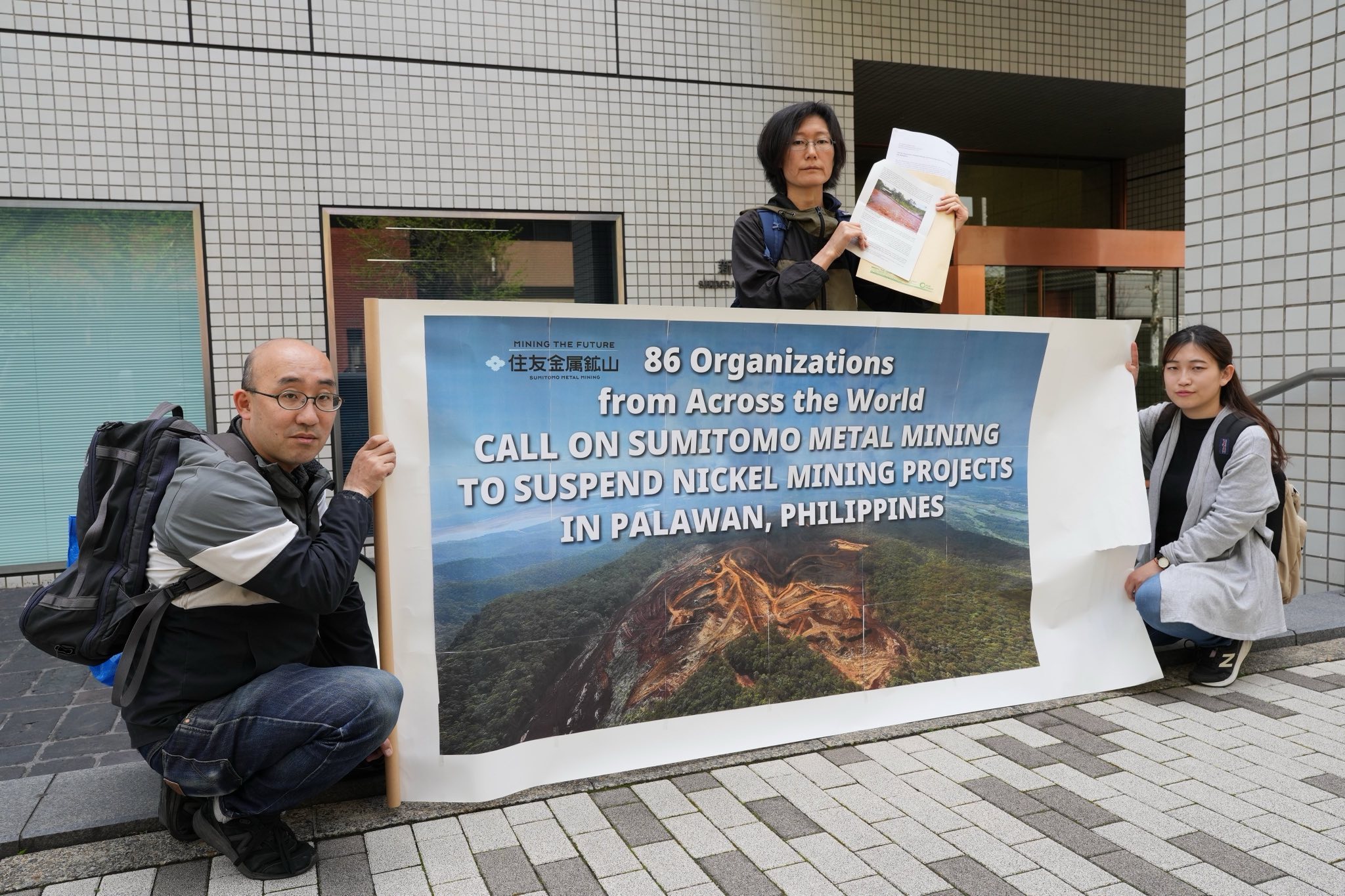
On April 14, 2025, 86 civil society organizations, including those working at international and regional levels plus organizations working nationally in 39 countries, submitted a petition to call on Sumitomo Metal Mining Co., Ltg. (SMM) to immediately suspend the Coral Bay Nickel Processing Project and the Rio Tuba Nickel Mining Project in Palawan until effective and publicly verifiable countermeasures are developed and implemented to avoid destructive impacts on local communities. On the same day, the initial conveners for signatures on the petition (Environmental Legal Assistance Center (ELAC), Legal Rights and Natural Resources Center (LRC) / FoE Philippines, Pacific Asia Resource Center (PARC), Friends of the Earth Japan) also launched a website to collect individual signatures.
According to a recent report by an expert who has been conducting water quality surveys since 2009 in cooperation with FoE Japan, hexavalent chromium exceeding domestic and international environmental standards has been detected constantly during the rainy season at a fixed point in the Togpon River flowing from the existing mining concession of the Rio Tuba Nickel Mining. In September 2024, the highest concentrations of hexavalent chromium was observed in 15 years of water quality studies. It is clear that the projects have failed to effectively address water pollution for more than a decade, despite the repeated calls of civil society groups for action.
With expectations of growing global demand for nickel in the context of efforts toward a decarbonized society, mining operations have begun to expand in the region. However, as no effective pollution mitigation measure has been taken to date, it is highly likely that similar water pollution will spread to other rivers. It is undeniable that indigenous peoples and farmers who depend on the rivers for their daily lives and agriculture in the vicinity of the projects may be adversely affected for decades to come. More local communities will also be exposed to health damage risk because hexavalent chromium is a highly toxic substance that is carcinogenic and also causes skin irritation, etc.
SMM is the parent company (100%) of Coral Bay Nickel Corporation (CBNC), which has been operating the HPAL processing plant in Batarasa of southern Palawan since 2005, and all the nickel-cobalt mixed sulfide produced by CBNC is exported to SMM’s plants in Japan to produce battery materials, etc.. The company’s battery materials have been officially adopted by Tesla as well as by Toyota Motor Corporation for their in-car batteries. The company also have a 26% stake in Nickel Asia Corporation (NAC), the largest shareholder (60%) in Rio Tuba Nickel Mining Corporation (RTNMC), from which it procures raw materials.
Shigeru Tanaka, Executive Director of PARC, noted that “The only reason climate change has become such an urgent issue is because developed economies have failed to act for decades. Communities in the Philippines should not have to pay the price for the need for swift decarbonization. It is time we put a stop to this reckless, unsafe and irresponsible mining, and seriously debate other means of realizing the Paris Climate Goals. It is at least clear that this mining will not even pass the smell test on human rights due diligence.”
Leon Dulce, Campaigns Support and Linkages Coordinator for LRC-FoE Philippines, stated that “The CBNC-SMM’s longstanding environmental damages are a clear example of an unjust energy transition mineral pathway. It means electric vehicle corporations like Panasonic and Tesla are profiting from CBNC-SMM’s nickel value chain while host communities in the Philippines are left to suffer miniscule royalties that pale in comparison to the damages caused by hexavalent chromium pollution. Both Japan and the Philippines are violating international accountability frameworks such as the UN Guiding Principles on Business and Human Rights–which are increasingly recognized by courts around the world such as in the Netherlands’ Vereniging Milieudefensie et al. v. Royal Dutch Shell PLC case as a requirement that governments must observe.”
Hozue Hatae, FoE Japan’s Development and Human Rights Team Campaigner, commented, “From the results of the 15-year water quality surveys we have conducted in the vicinity of the Rio Tuba Nickel Mine, it is clear that SMM along with allied businesses have still failed to develop and implement effective water pollution control measures. The well-being of local communities must not be threatened in the long term under the name of “decarbonization”. In order to protect the health, livelihoods, and human rights of the local communities living around the projects, SMM must fulfill its responsibilities as an investor and procurer by suspending its nickel mining and smelting operations in the region until effective measures are developed and implemented in a transparent manner.”
“ELAC is very much concerned that despite our existing laws on natural forest such as the Strategic Environmental Plan for Palawan, a Special Tree Cutting Permit was issued to the Rio Tuba Nickel Mining Corporation to cut 52,000 trees in Mt. Bulanjao Range. There have been studies on the presence of old-growth forest and the rich biodiversity of Bulanjao Range. This is very disturbing because there is a watershed in the area and there are farmlands below the range. Until now we have not completely resolved the pollution of lowland areas in the last decades. With the removal of thousands of trees, deforestation, displacement of wildlife and local communities will be the adverse consequences. This will ultimately put at risk our biodiversity and communities’ welfare and make them less climate-resilient.” said Grizelda Mayo-Anda, Executive Director of ELAC.
Source: FoE Japan
.