

Mining industry to push sustainability
By Eireene Jairee Gomez | The Manila Times | August 14, 2021
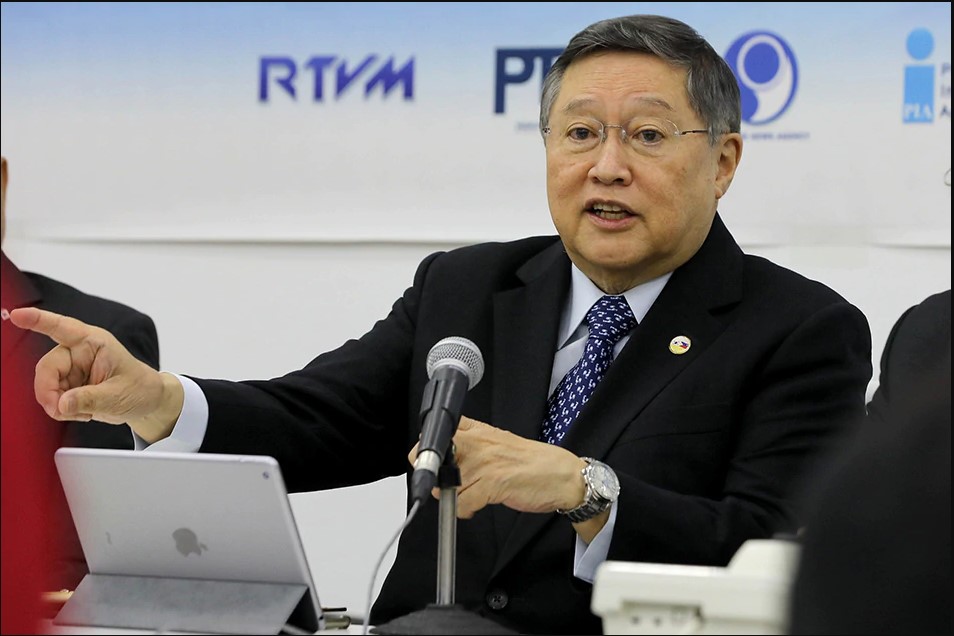
Finance Secretary Carlos Dominguez III during a press briefing at the Imperial Palace Botique Hotel in Seoul, Republic of Korea on June 5, 2018. Alfred Frias, Malacanang Photo/File
THE government will strictly enforce the “non-negotiable condition” on the mining industry for it to adopt environmentally sustainable and responsible extractive practices to guarantee the sustainability of this potential economic growth driver, Finance Secretary Carlos Dominguez 3rd assured.
Speaking at the opening of the Mining Industry Coordinating Council (MICC) Mining Review Dissemination Forum, Dominguez highlighted that it is crucial for the government’s policy decisions on mining sector to be aligned to facts and science.
To ensure an objective assessment that will result to policy and regulatory reforms for the industry, he said the interagency MICC had commissioned independent, multi-disciplinary teams composed of technical, legal, social, economic and environmental experts to undertake a review of large-scale metallic mines in the country.
These teams, which worked from February 2018 to December 2020, have submitted their recommendations covering their two-phase review of 44 large-scale metallic mines operated by 43 companies, said Dominguez, who co-chairs the MICC with Environment Secretary Roy Cimatu.
In the succeeding phase of the comprehensive review, Dominguez said the MICC plans to cover priority mining and quarry operations across the country including some mines located in the Bangsamoro Autonomous Region in Muslim Mindanao (BARMM).
The finance chief said he expects the experts’ recommendations to raise public awareness about the value of mining to the economy and elevate the quality of debate on the regulatory regime governing this industry, “firmly grounding it on facts and science.”
“As the Philippines fights its way out of the economic downturn and back to the path of vigorous growth, every sector of business activity is important. The Duterte administration recognizes that mining is potentially a driver of our economic recovery. In fact, it is pushing the revival of the industry to provide jobs and energize economies in the countryside,” Dominguez said.
“The Duterte administration is doing its utmost to ensure that the mining industry will strictly adopt environmentally sustainable and responsible extractive practices. This nonnegotiable condition will help guarantee the sustainability of the industry and the vibrant economic future of its host communities,” he added.
The Philippines, Dominguez noted, is one of the countries in the world rich in mineral resources, which can benefit the economy and if responsible and sustainable practices are strictly adhered to by the mining industry.
On top of creating jobs and driving the growth of local economies, Dominguez said mining projects also lead to additional investments in infrastructure, utilities and other social development initiatives that benefit their respective host communities.
“It is therefore crucial to ensure that we align our policies for this industry to facts and science. Otherwise, policy decisions could wreak havoc on an industry on which many local communities depend on,” Dominguez said.
He noted that “wrong-headed policies” could end up damaging the environment instead of protecting it as he recalled the time when mining regulation “was so politicized that informal and small-scale mining operations were allowed to be completely unregulated.”
Dominguez said the comprehensive review ordered by the MICC, provides a venue “to share its findings and lessons – both good and bad – with a view to raise awareness that will lead to policy and regulatory reform.”
The mining audit was mandated by Executive Order 79 in 2012, which directs the MICC to undertake a multi-stakeholder review on the performance of existing mining operations.
Source: The Manila Times